

(english version below)
The Crunchtime – Where the Rubber Hits the Road
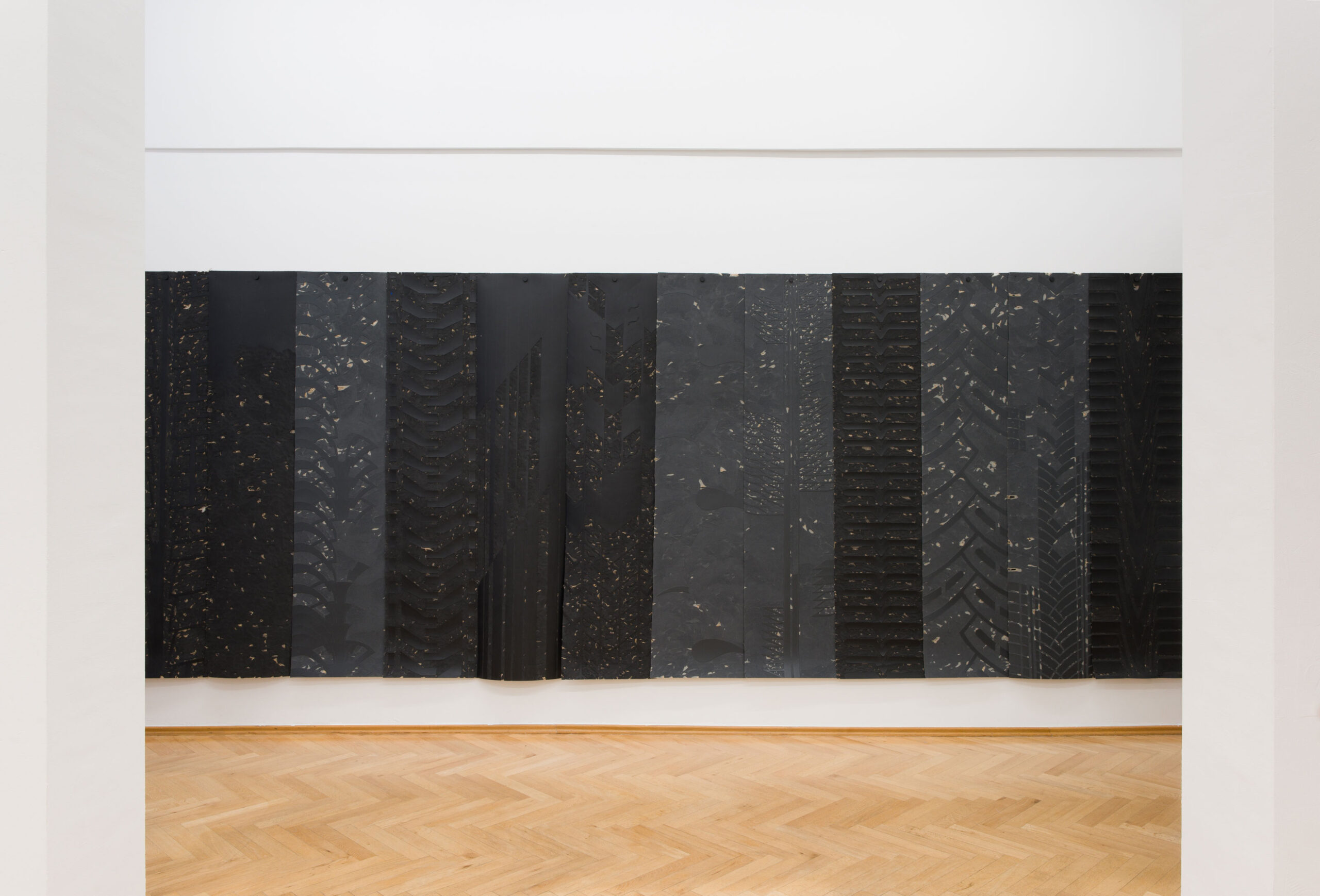
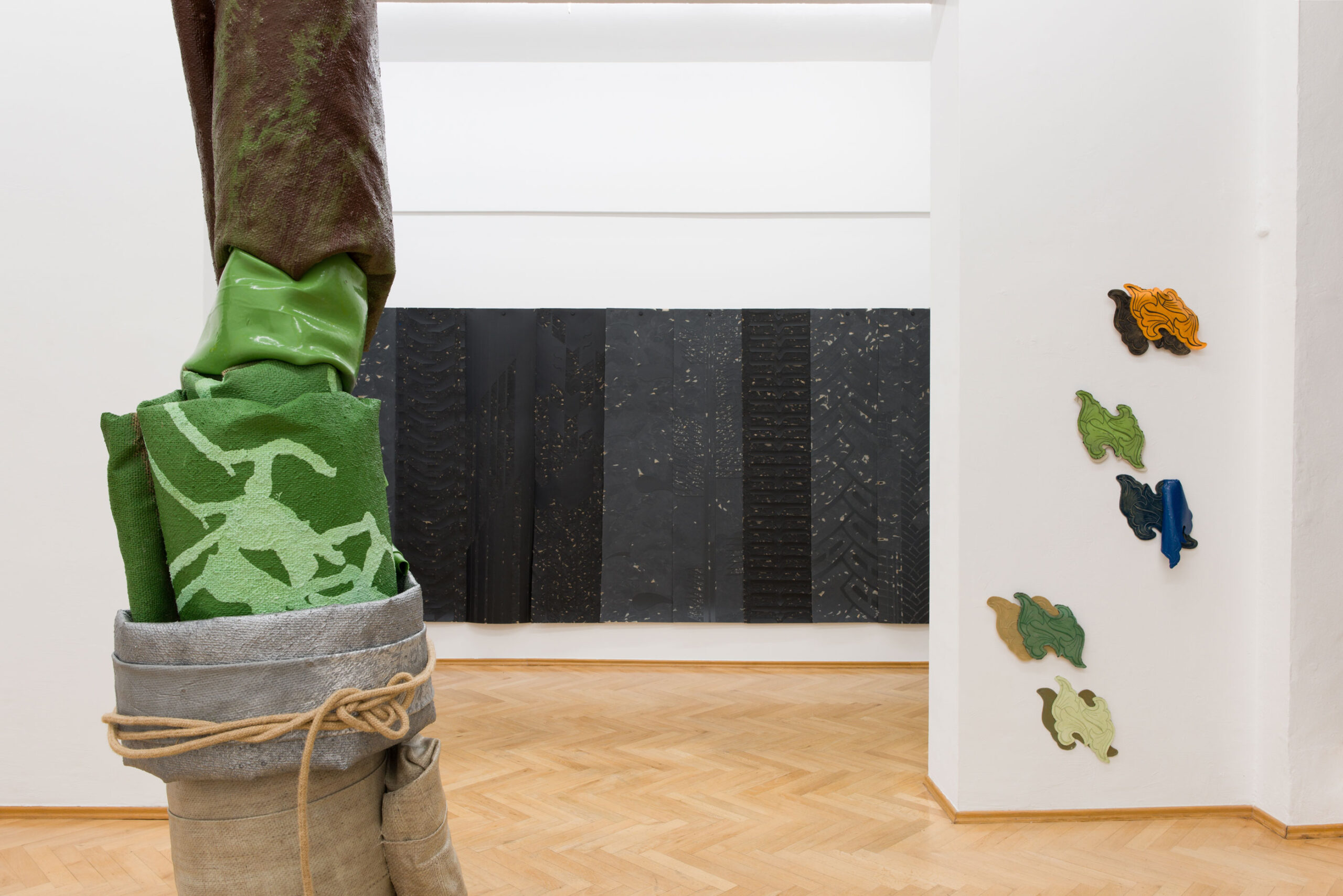
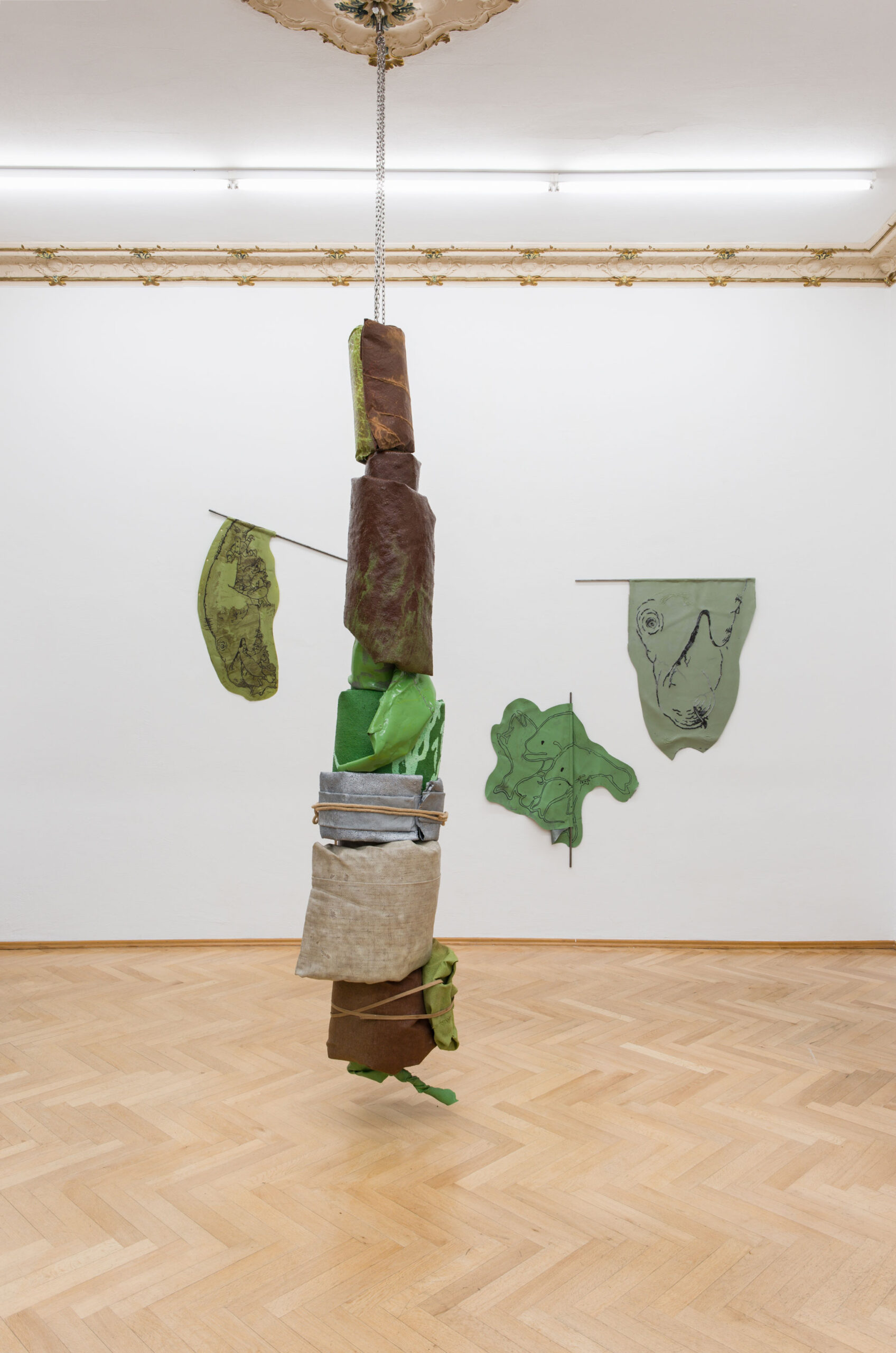
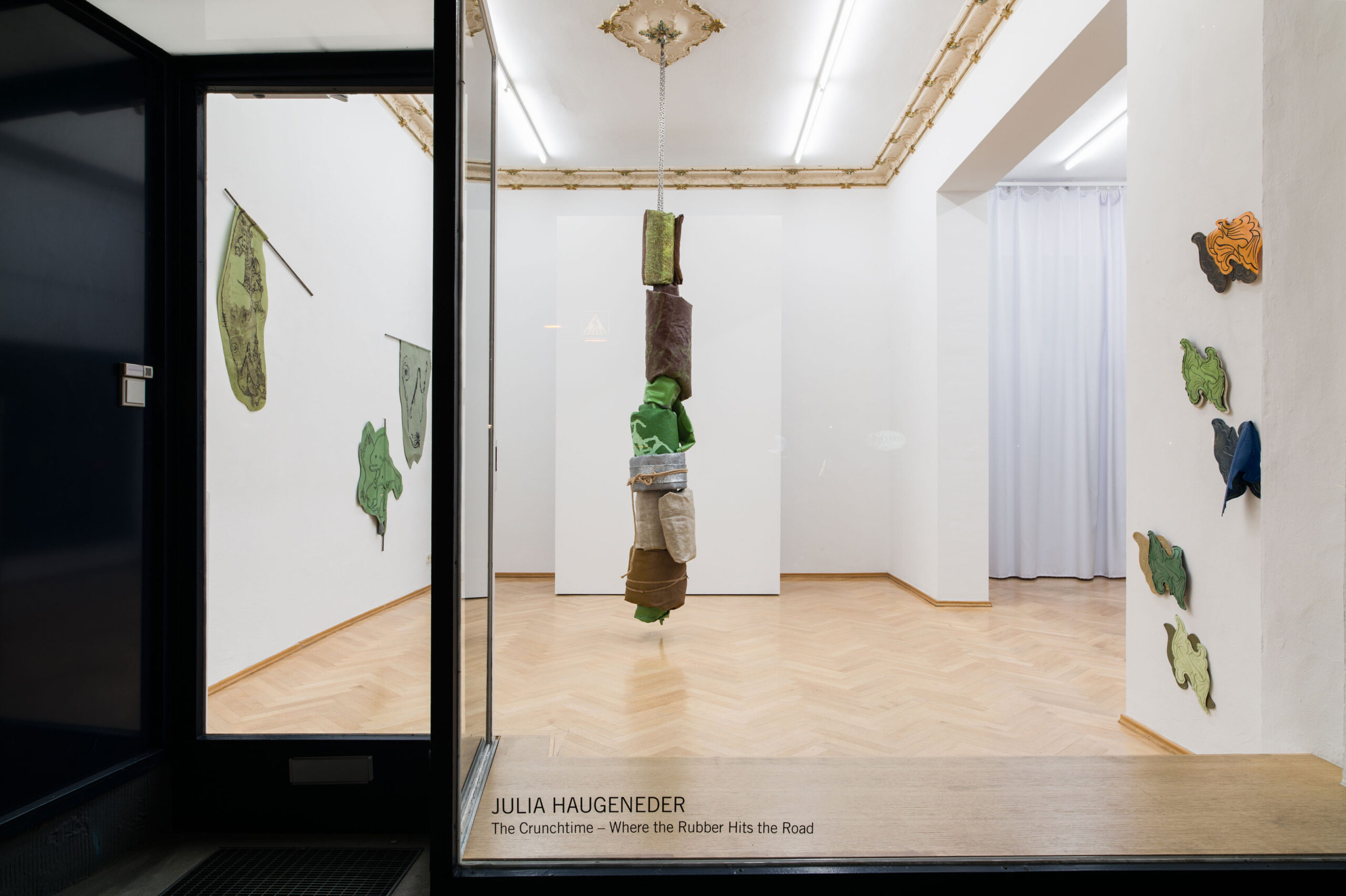
Julia Haugeneder aus Wien zeigt zentral die hängende Skulptur Nimrod, im rechten Raumteil den Linolschnitt Where the rubber hits the road und an der linken Wand die an Fahnen erinnernde Arbeit Naturvertrag.
Naturvertrag besteht aus Buchbindeleim und bezieht sich in seiner Zeichnung auf Pieter Bruegels Die großen Fische fressen die kleinen (1556). Was bei Bruegel als Metapher für die Unbarmherzigkeit der Natur erscheint, erinnert heute eher an ein Meerestier, das an Plastikmüll zugrunde geht.
Nimrod, ebenfalls aus Leim sowie Jute und Holz, verweist durch seine vertikale Aufschichtung auf Pieter Bruegels Turmbau zu Babel (1563). Der Linolschnitt Where the rubber hits the road erinnert mit seinen Mustern an die Profile von Autoreifen.
Crunchtime bezeichnet die entscheidende Phase, in der aus abstrakten Umweltstatistiken erlebte Realität wird – den Moment, an dem es beinahe zu spät ist. Haugeneder setzt sich in ihrer Arbeit mit Verschleiß und Erschöpfung auseinander. Jedes Jahr gelangen über 10 Millionen Tonnen Plastik in die Meere, wobei der Reifenabrieb zu den bedeutendsten Quellen von Mikroplastik gehört.
Haugeneder möchte jedoch keine Apologetin der These eines „too late capitalism“ sein. Vielmehr versteht sie ihre Ausstellung als Recherche darüber, wie sich jenseits der Faszination für endzeitliche Szenarien und Dystopien eine demokratische Auseinandersetzung darüber führen lässt, wie eine Gesellschaft für ein besseres Leben organisiert werden kann – und wie solche Formen des gemeinsamen Handelns gefunden und eingeübt werden können.
The Crunchtime – Where the Rubber Hits the Road
Vienna-based artist Julia Haugeneder presents the suspended sculpture Nimrod at the centre of the exhibition, the linocut Where the Rubber Hits the Road in the right-hand section of the room, and the flag-like work Naturvertrag on the left-hand wall.
Naturvertrag is made from bookbinding glue, and its drawing refers to Pieter Bruegel the Elder’s Big Fish Eat Little Fish(1556). What appears in Bruegel’s work as a metaphor for the ruthlessness of nature today evokes instead a sea creature perishing from plastic waste.
Also made from glue, jute and wood, Nimrod refers through its vertical layering to Pieter Bruegel the Elder’s The Tower of Babel (1563). With its patterns evoking the tread of car tyres, the linocut Where the Rubber Hits the Road recalls tyre tracks.
Crunchtime describes the decisive phase in which abstract environmental statistics become lived reality – the moment when it is almost too late. Haugeneder’s work explores wear and tear and exhaustion. More than ten million tonnes of plastic enter the oceans every year, with tyre wear among the most significant sources of microplastics.
Haugeneder does not, however, seek to advocate the thesis of “too late capitalism”. Rather, she sees her exhibition as an exploration of how, beyond our fascination with apocalyptic scenarios and dystopias, a democratic debate might be opened around how society can be organised for a better life – and how forms of collective action can be developed and practised.
